Ground some 150km east of Alice Springs in the Northern Territory was the site of Australia’s first recorded mining rush with the apparent discovery of rubies within the Hale River in 1886, but it was a mirage.
The rubies were actually garnet, and the region slipped from favour as an exploration destination aside from industrial minerals and keen fossickers, but the area has been put back on the radar over the past six months with the arrival of New Frontier Minerals.
The company, then known as Castillo Copper, secured earn-in rights for 85% of the Harts Range project, which NFM senior consultant Kevin Das called a treasure box of modern minerals, with the potential for deposits containing heavy rare earths, uranium, niobium, and tantalum, 120km northeast of Alice Springs.
“Where you get one, you get them all. It’s quite unique in that sense,” Das said.
Das was a senior geologist with Northern Minerals in 2010 when that company was completing early rock chipping at what is now the advanced Browns Range project in Western Australia’s Kimberley region.
While the anomalies in central Australia are pegmatite-hosted, different to the hydrothermal mineralisation at Browns Range, Das told MNN the data for both areas showed the distribution of HREEs is largely the same.
Heavy rare earths are selling for multiples of the better-known light REEs, such as neodymium and praseodymium, which are the focus of other Australian developers such as Hastings Technology Metals, Arafura Rare Earths and Lynas Rare Earths.
Terbium is priced at around US$800/kg and dysprosium $203/kg, compared to light REEs that are around $50/kg on a good day.
Little wonder they are driving New Frontier’s focus.
Das, who also worked with the vendor group, said exploration started with a recent airborne electromagnetic survey looking for uranium anomalies – the first survey since the 1990s.
The theory is that where you have uranium you will have HREEs, and the survey results appear to support that.
Encouragingly, the targets appear to have a structural component linked to the Bruna Zone, Entia Dome, and cross-cutting structures. A possible magnetic anomaly, potentially linked with an underlying intrusion, was also defined.
The main prospects so far are the existing Cusp and Bobs targets, where there are consistent high grades associated with a 5km-long east-west trending structure.
Rock chipping in the area has delivered up to 31.48% niobium, 15% uranium and 12.7% REE, with the highest values at Cusp.
Of the HREE, sampling returned up to 2.85% dysprosium and 0.32% terbium.
NFM has added to the known prospects with a new 500m-long pegmatite discovery, Big Jay, and copper anomalism at Cusp North with up to 2.25%.
Multiple targets
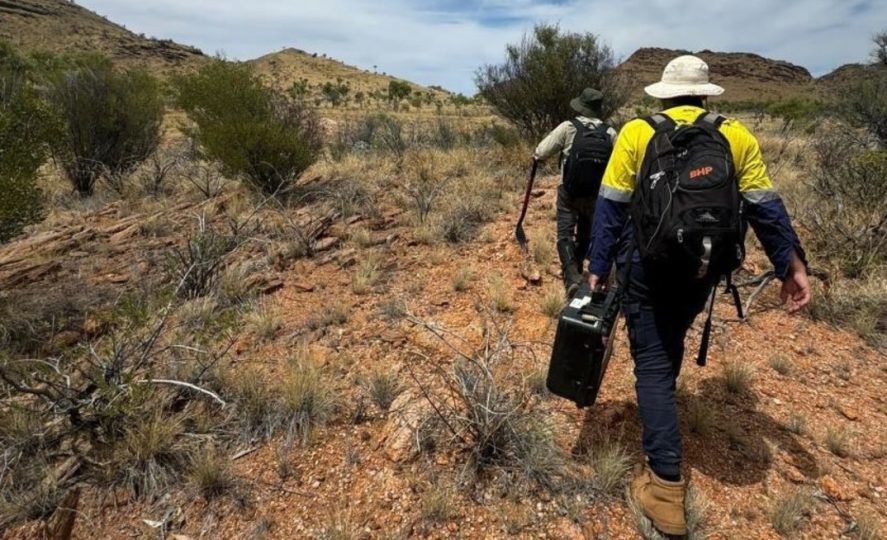
There are now some 46 anomalies that will be visited over the next few months for additional rock chipping and mapping, 18 of which are defined as high priority targets.
At the end of the fieldwork season the data will be used to define exploration drilling plans – the first ever in the area for its target minerals and likely the deepest, given past work was limited to 60m.
“We want to line up as many as we can to drill,” Das said.
He told MNN that the nature of the mineralisation had already sparked third-party interest, given the scarcity of HREE projects outside China.
Browns Range is one, and Harts Range could become only the second in Australia.
Northern Minerals is looking to finally get into commercial production later this decade, sending its ore to Iluka Minerals’ planned $1.8 billion Eneabba refinery, which would be an option for NFM.
Between then and now there is a lot of work to do.
With rock chips regularly returning above 10% uranium at surface, it will be looked at as a significant byproduct.
“If you’re looking for uranium in Australia, the NT and South Australia are really where you want to be,” Das said.
Niobium has really only been on investors’ radar for the past few years, and could also add value.
That’s all a metallurgical puzzle for further down the track.